Tuesday, September 30, 2025

BLOOM AGAIN: a novel


I'm happy to announce my newest book and my first work of fiction, BLOOM AGAIN. In this novel, I bring together art and science and the natural world in new and exciting ways. Yes, that's Kudzu and a Polar Bear on the book's cover, and, yes, these two do not live in the same parts of the world, but they do come together in this story. Art and science and imagination and the ways in which we live and the ways in which we could live if only we paid attention more to the world beyond humans. Both main characters, Astrid and Elyse, experience moments in the natural world with nonhuman beings where they find inspiration - and that inspiration and insight is, in fact, because they are attuned and listening to the other living beings - Polar Bear, Kudzu, Mountain, Swamp - that they are among. This is what it's all about. I know this blog is mostly silent, mostly paused, but I just had to share this here, to whomever is listening....

Sunday, September 4, 2022


How shall we live? Turning to the natural world

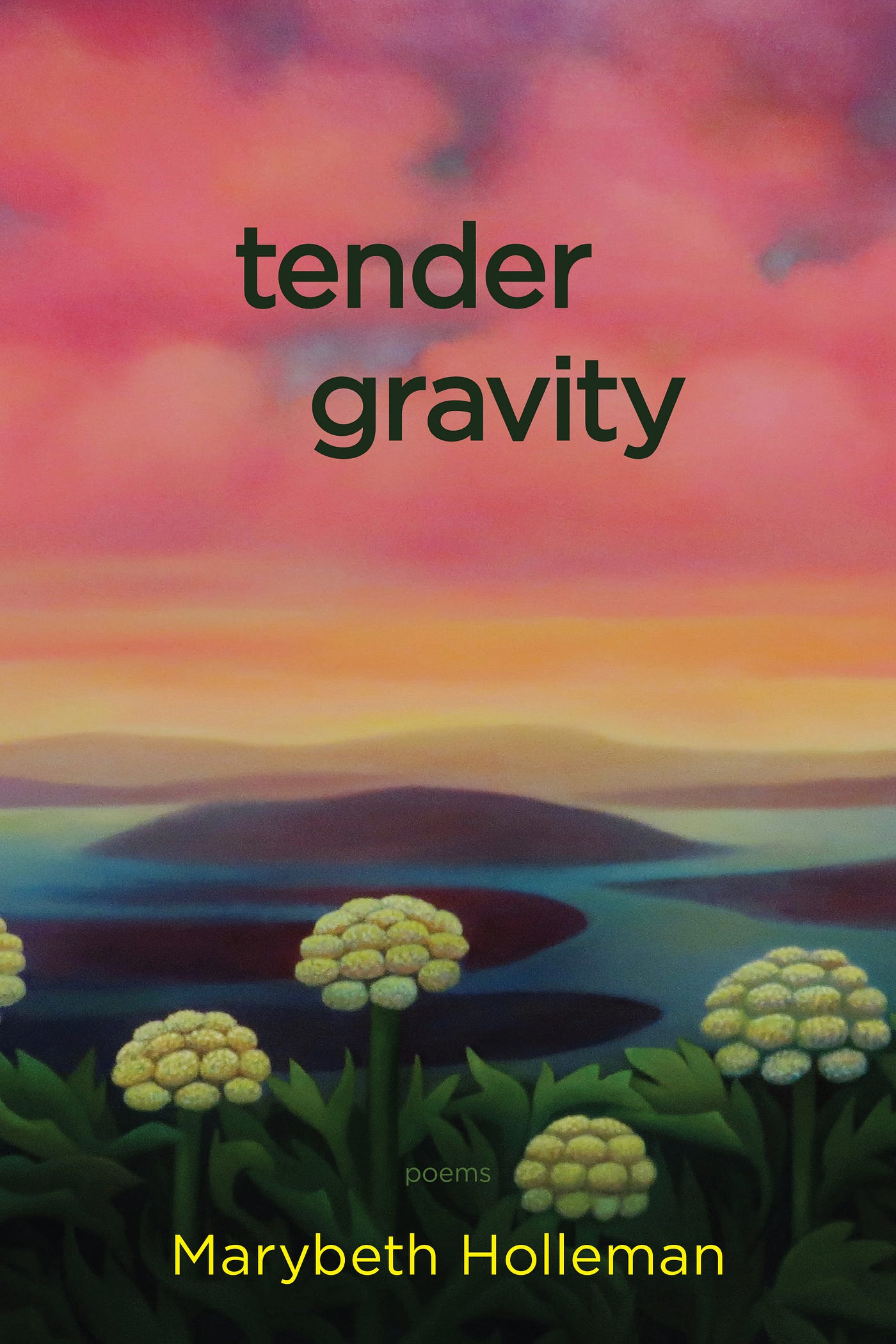
The cover of tender gravity with a drawing of a field with flowers and mountains
The cover of tender gravity
A photo of sliding rock in Asheville, North Carolina with two people sliding down the rock
Sliding Rock in Asheville, NC. Photo credit: Forest Service, USDA, Flickr
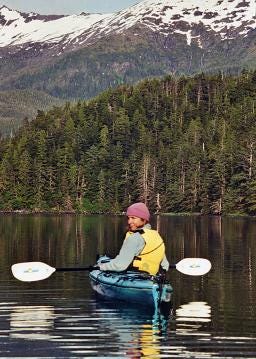
A photo of Marybeth kayaking in Alaska with a forest in the background
Marybeth kayaking through Alaska. Photo credit: Marybeth Holleman
A hermit thrush standing on a branch
A hermit thrush standing on a branch. Photo credit: Wikimedia Commons

Tuesday, May 31, 2022


I'm happy to announce my forthcoming debut poetry collection, tender gravity.

And I'm honored to have such amazing poets provide this ADVANCE PRAISE ---


“Holleman writes with the crystalline clarity of the north that is her home. In the company of humpbacks, ravens, moon jellies, and sphagnum, she seeks consolations that serve as antidote to the otherwise intolerable grief and violence of the human world. ‘We want the vast / to cleanse transgressions we carry,’ she writes, and that desire illuminates these poems.”

—Alison Hawthorne Deming, author of Stairway to Heaven


“Such intimate knowledge of place tethers the ecopoetry of Marybeth Holleman’s tender gravity to the land and seas around her home in Anchorage, Alaska. There is sorrow in these poems—for a murdered brother who is remembered in the haunting lines of “the warm dark,” and for all the oil spills, global warming, the vanishing species—but also serenity and a piercing love. The poems’ longing for enlightenment is fulfilled not through renunciation but through closer and closer attention to the actual light “that breathes wide // up mountainside to ridgeline across alpine field studded with lichen-red rocks,” the “light / glinting off cobalt pool,” the “light mediating fields awash in tasseled grass / to burn luminous amber.” This is a beautiful book.”

—Ann Fisher-Wirth, author of The Bones of Winter Birds


“Stand on your 52 / bones” and allow these poems to call you into connection with the world. tender gravity expands the beautiful, necessary work of writers doing healing and challenging our disconnection from the nonhuman. Marybeth Holleman’s poems, in particular, draw strength from her longtime home in Alaska. That deep, place-based connection allows us to live and look a while with her at her world in a deeper, more nuanced way. “I apologize to the god of words / but the god of dirt calls to me,” she writes as she grapples with ecological losses (climate change, the long and brutal aftermath of the Exxon Valdez oil spill) and personal losses (a murdered brother, one’s own younger selves as the years move on). Perhaps the urgent hope of tender gravity is best encapsulated by the poem “With,” where the refrain of connection intensifies, connecting everything—beings and moments and memories we live with—which is, indeed, what happens when we truly allow ourselves to be open to the world.

—Elizabeth Bradfield, author of Toward Antarctica


“Marybeth Holleman’s tender gravity is a thoroughly absorbing collection whose poems range from personal epiphanies to works with larger philosophical implications. They cover a wide range of emotions, including grief for a murdered brother and celebrations of the beauties and consolations of nature. Some of the poems are reminiscent of the work of the wonderful nature poet Mary Oliver, and at least one is Whitman-like in its expansiveness.”

—John Morgan, author of The Moving Out


The poems in tender gravity by Marybeth Holleman are truly gems, beautifully honed to cast and reflect the inner and outer light of her subjects. Many of her poems reveal and enhance details of the skies and seas, lands, mountains, flora, and fauna of our most northern State: “Whales at Night,” “The Fantastic Skies of the Orphan Stars,” “How to Grieve a Glacier.” Her words and their cadences also offer new perspectives on experiences in our daily lives: “Yesterday on a Familiar Trail,” “The Remembered Earth,” and many more. Holleman’s book is a remarkable treasure.

—Pattiann Rogers, author of Quickening Fields


“What if / you could hold/ forty times/ your weight / in love?” writes Marybeth Holleman in her poem “Sphagnum,” which lingers, exploring the marvels of moss. As well as delighting in its attention to its subject, the poem also turns on its willingness to find in this rich green sponge some guidance for how to live a human life as well. tender gravity is full of moments like this, which fathom happiness among sundews and simultaneously mourn and delight in melting glaciers. Holleman looks carefully for her teachers in unexpected places: one poem speaks of a dead wolf left to brine in cold water for a season, then brought up so that we can admire the skull. Among Holleman’s teachers—wolf skull, sundew, glacier, and moss—is also loss itself, her own process of fathoming the murder of her brother. As these poems move through a big Alaskan landscape and also bend in attention to grief, they seek and find temporary refuge “in the variations in / the beat of a heart.” “Every wisdom slips away / as soon as I try to name it,” Holleman says, but what slips also shimmers, caressed in Holleman’s keen attentions. tender gravity is a book of hunger, and of restoration.

—Tess Taylor, author of Rift Zone

Monday, July 6, 2020

Poetics for the More-Than-Human World


I'm happy to have my poem, "with," included in this amazing new anthology, Poetics for the More-Than-Human World: An Anthology of Poetry and Commentary

It's an impressive collection, including such luminaries as Jane HirshfieldRae ArmantroutMei-mei BerssenbruggeRachel Blau DuPlessis, and Arthur Sze
I'm thrilled and humbled to be in such great company.

The entire collection is available now, online, and will appear in paperback this fall.

We're doing a series of Zoom talks/readings every Thursday, 4pm ET. You can register to attend these readings on Eventbrite hereI'll be reading July 30th.

My contribution, "with," brims with the array of my relations with more-than-humans, like this red squirrel. You can read the full poem here.

During this Anthropause, it's heartening to remind ourselves of the more-than-human world and their vital, irrepressible thrumming among us.


Saturday, January 4, 2020

DH Lawrence: what a catastrophe


            Winter Solstice, Turnagain Arm, Alaska.

Oh, what a catastrophe, what a maiming of love when it was made a personal, merely personal 
feeling, taken away from the rising and setting of the sun, and cut off from the magic connection of 
the solstice and equinox. This is what is the matter with us. We are bleeding at the roots, because we
are cut off from the earth and sun and stars, and love is a grinning mockery, because, poor blossom,
we plucked it from its stem on the tree of Life, and expected it to keep on blooming in our civilized 
vase on the table.

                                                                                                                                         ~ D.H. Lawrence


Saturday, October 19, 2019

What We Talk About When We Talk About Wilderness

Iceberg viewpoint, Tracy Bar

Iceberg Viewpoint, Tracy Bar, Tracy Arm Ford's Terror Wilderness, Tongass National Forest.


It's October, and my summertime wilderness adventures are behind me. Now I sit with my photographs and journals and memories, and find what the wilderness has given to me, feel how the wilderness has changed me, and always for the better.

Several years ago, I had the great opportunity, as part of the Voices of the Wilderness Program, to accompany wilderness rangers in the Tracy Arm Ford's Terror Wilderness of the Tongass National Forest. 

Just this last year, my essay from that extraordinary trip was published in the fine journal, Minding Nature, the journal for the Center for Humans and Nature

I'm grateful it's also online, so you can read it here.

Monday, February 18, 2019

Mary Oliver: The Chance to Love Everything


Mary Oliver was not just an American poet; she was an American prophet. She was not only one of the most popular poets in American literary history; she wrote in the same vein as Ralph Waldo Emerson and Walt Whitman about the world, and humanity’s place in it.

Like a modern-day Emily Dickinson, she rarely traveled far from home. When she did, she hardly wrote about it. No, poem after poem grew from the minute and endlessly fascinating forests and seashores of her home in Cape Cod. She wrote again and again about the black snake, the snapping turtle, the wild roses, the surging sea. Each time, she brought us new insight into our own world.

I speak in broad strokes. But her poetry means so much to me, and has for a very long time. I didn’t appreciate poetry until I read her work. I rarely read it, hardly understood it. Mary Oliver’s poems opened me to all poetry. Through hers I began to read others, and now my shelves burst with poetry books and my head is aswirl in poems I’ve memorized and I find myself writing poetry.

The beauty of Oliver’s work is many-fold. It is accessible: many who read her poems would not otherwise read poetry at all. It is rooted in the classics: she once said that she found her two true loves early in life: nature and dead poets. Steeped in the classics and roaming the world beyond humans, she found truths that resonate deeply.

Many poets and critics express disdain for her work, but the form of poetry is wide, and large enough to hold it all. Her poems, like Dickenson and Whitman before her, reach multitudes; her tribe is vast and varied.

I first heard her poems at an Audubon camp on an island off the coast of Maine. I was in college; I had gotten a scholarship to attend the camp for teachers and writers; I was a nascient environmental writer inspired by Edward Abbey and Rachel Carson. One night around the fire, a camp instructor recited “Wild Geese.” Like him, I memorized it.

Years later, at a writer’s conference in Montana, a group of us spontaneously recited that poem together. What joy: that “You do not have to be good.” That “You only have to let the soft animal of your body love what it loves.” That “the world offers itself to your imagination, over and over announcing your place...”

The thing is, in her I found someone who loved the more-than-human world the way I do: deeply and fully, with an unabashedly fierce allegiance, and with no assumption of human superiority. With, in fact, quite the opposite: her poems remind us that the more-than-human world has much to teach us. She was the willing supplicant, the monk wandering the fields and shores all day to listen and transcribe.


Isn’t it plain the sheets of moss, except that
they have no tongues, could lecture
all day if they wanted about
spiritual patience?
                ~ Landscape


A poet that titles a book What Do we Know has realized this essential truth: that we humans do not know very much at all, though we act as if we know it all. That this hubris is our downfall, and with it, much of the wild and wonderful world. But though she did not avoid the sorrows, she continuously sang the songs of praise for the world that is.

Her poems are an integral part of my life. I read “The Sun” aloud to my family every summer solstice. “The Chance to Love Everything” hangs on my wall joined to a crayon image of the Earth my son drew when he was seven. Lines ring in my head:

I don’t know exactly what a prayer is.
I do know how to pay attention, how to fall down
into the grass, how to kneel down in the grass,
how to be idle and blessed, how to stroll through the fields,
which is what I have been doing all day.
~The Summer Day


such wild love—
do you think there is anywhere, in any language,
a word billowing enough
for the pleasure

that fills you,
as the sun
reaches out,
as it warms you

as you stand there,
empty-handed—
or have you too
gone crazy
for power, for things?
~ The Sun


For years and years I struggled
just to love my life. And then

the butterfly
rose, weightless, in the wind.
“Don’t love your life/ too much,” it said,

and vanished
into the world.
~ One or Two Things

When Mary Oliver died on January 17, through my grief I felt gratitude. I am grateful that I found her poetry. Grateful to all the editors and publishers who let her work out into the world. Grateful that she wrote them, day after day, walking the woods and the dark ponds and then sitting at her desk, so that they could find their way to me.

Tuesday, November 27, 2018

The current issue of Canarya literary journal of the environmental crisis, contains two of my poems. Here's one:


Whales at Night
by Marybeth Holleman
they come
after the day’s
fishing fleet
has gone to anchor
awaken us
with a sigh
that sounds human
but is whale-breath
the long exhale
after a deep dive
sprays dappling
concentric rings
left by their arcs
into air
on an otherwise
silent and glassy
sea


Tuesday, August 21, 2018

Writing for Animals: an interview

                      Red-throated loon pair with chick on a small lake near Nome, Alaska.


My essay, "Other Nations," is included in the new anthology WRITING FOR ANIMALS. Below is a Q&A between me and the book editor, Midge Raymond, first published on the Ashland Creek blog.


Midge: In what ways has your writing changed as your knowledge and awareness of animals has evolved?
Marybeth: It’s become more challenging, and more interesting. The more I learn and experience the more-than-human world, the more I see the need, as a writer, to be a conduit for them — for my writing to speak for them, in some way. This became very clear to me following the 1989 Exxon Valdez oil spill in Prince William Sound. This was a terrible industrial disaster that took thousands of wild lives, threatened generations more, and permanently degraded a huge swath of coastal wilderness. I witnessed the way humanity considered this disaster as compared to a disaster in which it was human lives that were lost. I realized then that the best I could do was try to give voice to these nonhuman lives, as best I can and in full awareness of the filters I carry as a human.
It’s very challenging, for they’re not like us, and yet, in ways, they are…how to write that? Not by being overly anthropomorphic, which is a disservice to other animals’ true selves, but also not by being anthropocentric, which is also a disservice and a lie. They are not, regardless of the unfortunate legacy of Descartian thinking, mere machines. And it’s fascinating, as a writer, to lean in on that, to step beyond the convenience of either/or thinking, to question pat answers, and to really witness the truths of their lives. In early June on the Kenai River, my husband and I watched salmon jump. Why, I asked my biologist husband, do salmon jump out of the water? He starting to recite theories – to loosen the eggs, to rid of parasites…Well, we don’t really know. And I love that; I love that we don’t always have some clear and constant explanation for what another being is doing. The salmon jumping: What if it’s just for fun, or just for the rush? What if there’s no reason at all, except joy?

Midge: What is the most important thing you feel writers should keep in mind as they write about animals?
Marybeth: Balance. Standing in the middle. Embracing both/and rather than seeing things as either/or. We wield great power when we write about nonhuman lives; it’s easy for stories about animals to be dismissed as overly romantic or anthropomorphic or complete fantasy. If we want our stories to reach as many people as possible, we must be prepared to straddle beauty and terror, loss and life, differences and similarities. We have to balance our own humility and authority.
Humility. We must remember that our human knowledge will always be limited, regardless of how deeply we try to understand other lives. They are, as Henry Beston wrote, “not brethren, not underlings: they are other nations, caught with ourselves in the net of life and time, fellow prisoners of the splendour and travail of the earth.” For example, just because I’ve published a book about wolves doesn’t mean I know wolves. Even if I spent years living with wolves, even then, I would not claim to know what it’s like to be a wolf. In fact, what I’ve found to be true in writing about the more-than-human world is that the more I learn, the more I see how little I know. How little all humans know.
Authority. We must root our writing in unmediated experience. Spend time with the animals we’re writing about; write about what we actually see, hear, smell, feel. Do tons of research, read all the scientific information we can, but be sure to root our words in direct, actual experience. Then embrace the authority of our own experience and knowledge. In The Heart of the Sound, I described watching a mountain goat swim from Culross Island to the mainland. Scientists later told me there were no goats on Culross Island, and goats do not swim in saltwater. But I know what I saw. And I know, from that, that as much as science can teach us about the world, it is always —always — an incomplete picture.

Midge: Which authors/books do you feel do a good job of realistically and compassionately portraying the lives of animals?
Marybeth: Ursula LeGuin’s short story “The Author of the Acacia Seeds.” Yes, it’s science fiction, and fantastical, but it makes you think about language among nonhumans in a different light. It translates to reality. Then there’s Gretchen Primack’s poetry collection Kind, and Lisa Couturier’s amazing essay collection The Hopes of Snakes and lovely poetry collection Animals/Bodies. Nancy Lord has a great short story on a wolf-dog called “Recall of the Wild.” And there’s Annie Dillard’s “Living Like Weasels,” which is a brilliant description of one of those brief moments of unmediated connection with the nonhuman world.

Midge: You rerouted your career from environmental policy work to creative writing. In what ways do you feel this is more effective and/or rewarding?
Marybeth: Oh, so much more rewarding! Effective in a longer-lasting way. Policy can be undone quickly, as we’re seeing right now with many regulations that took decades to put in place. We’d like to think policy is done with a rational, reasoned, careful approach, but it’s just not. When I began work in environmental policy, I learned fast that the problem wasn’t, as I’d naively assumed as a college student, some lack of information transmittal, some failure of communication between scientists and politicians. No, it’s a fundamental difference in intention and values and process. The political realm, in its present form, is fraught with poor decisions with no basis in scientific knowledge or rational thinking…much less the kind of both/and openness that I spoke of above. For example, here in Alaska, the state put in place a no-kill buffer for wolf protection along the boundary of Denali National Park…and then took it away simply out of spite over an unrelated political spat.
Writing, on the other hand, lasts. We still read stories — unabridged, unmediated — that are hundreds of years old. Writing can reach people on a deeper level, a subtle plane, one they may not even consciously recognize. Story bypasses the analytical mind and aims straight for memory and imagination. Story has power; it makes people more empathetic, more able to enter the world of the Other. It is transcendent in its potential to effect change.
The downside is that, with policy work, you can see the effects of your work — whether success or failure — very clearly and sometimes quickly. When they put the wildlife buffer in place, wolves stopped being killed, and more wolves were seen in the park. With writing, you can’t, for the most part, see the effects. There are exceptions, of course: consider Silent Spring. But mostly we writers, and really, all artists, rarely witness any far-reaching effects from our work. Every now and then I’ll get a note from some reader that confirms what I’ve hoped — that my work is reaching people, is having an effect on their view of the world. But mostly I just have to have faith in what I cannot, and likely will never, see—in the ripple effect of my words as they find their way out into the world.

Cover Writing for Animals

Monday, June 18, 2018

The Petals of Summer


In honor of the season, here's a reprint of my essay recently published in River Teeth's Beautiful Things...


The Petals of Summer

They lie like bits of tissue on the bathroom floor rug, caught in the fibers; I bend to pick them up and see the yellow and pink threadworn veins, dry and broken and translucent pieces of geranium and nasturtium. Flower petal parts carried in on the soles of feet, bits I thank for summer’s beauty and drop into the trash. Outside, the deck on which they grew is bare and still, frozen and dusted with the season’s first thin layer of snow. Dead plants are piled on the compost, their pots stacked, garden chairs put away in the shed. White that gilds every twig and fallen leaf brightens the sky, and my room, all night a light sifting in the windows, keeping me awake, thin refraction of summer’s endless night. Seasons change but each holds in it the others, each reflects all the rest, same face turned another angle, same light falling, same colors pouring down from the sky to turn petals pink or yellow, petals I take from the trash and sow like winged seeds on the ground covered with white, covered with all the colors at once.


Click here to read the original post on Beautiful Things. 

Tuesday, January 2, 2018


That I am part of the earth my feet know perfectly, and my blood is part of the sea. There is 

not any part of me that is alone and absolute except my mind, and we shall find that the

mind has no existence by itself, it is only the glitter of the sun on the surfaces of the water.                                                                                                      
                                                                                                         ~D. H. Lawrence


Tuesday, November 21, 2017

How to be Fearless (and even Happy) in Frightening Times


For decades I’ve worked to shift the world toward peace and environmental harmony. It’s uphill work, and this past year I’ve seen the biggest setbacks yet. So, I created what I needed: a list of strategies for overcoming compassion-resistance fatigue.

It's just been published in Kosmos; click on this title to read the full list: How to be Fearless (and even Happy) in Frightening Times.


Tuesday, October 3, 2017

Banff Moments: Guest Post by Amar Athwal

A few years ago, a wildlife activist in Alberta forwarded an email called "Moment" from a photographer in Banff, British Columbia. I got on his email list and started getting, every so often, another "Moment" in my inbox: one of his gorgeous photos accompanied by a brief description. The photographer, Amar Athwal, is this entry's guest blogger. ~ Marybeth
 
 
Photography is my way of engaging with nature, my way of finding balance in life, my way of having a creative outlet and most important my way of sharing how amazing nature is. Everything in nature is my photography subject, from flora, fauna, landscapes, night sky, and more. Here are four examples:
 

 Blackpoll Warbler


We experienced a great spring bird migration this year; one of the reasons for that was seeing this male Blackpoll Warbler. A rare sight in our neck of woods. Few years back a study was conducted with these warblers, a half gram tracker was placed on the back of these 12 gram birds before they made their southern migration journey. Out of the 37 birds that were tracked, five were recovered the following year. From the information the trackers were able to gather, those five birds averaged 2,540 kilometers non-stop flight in roughly 62 hours, over the Atlantic Ocean. Just amazing.
 
 
Wood Lily


During the summer the colours are everywhere in the mountains and the western wood lilies play a big role in that. But only for about a month their beauty is on display, which is well worth stopping for (and for me well worth fighting the mosquitoes to get few good pictures). A quick picture is not good enough, I will walk around until I find the right flower with the right background. And if you don’t come back with dirt on your knees and elbows, then you did not try hard enough to get the best picture possible.


Grizzly


This large male grizzly was  busy during the mating season. At the start of the season he was following a female in the Lake Louise area. Then few weeks later he decided to cover about 60 kms over few days to see another female. Then he was back near Lake Louise with another different female. And only he knows what he was up to during the times he has not been spotted between those three encounters. He has been busy, covering the distance and keeping ahead of the larger males to mate with a willing female. And he still has few weeks to go before the mating season is over. Just a small window into the life of a male grizzly bear.


Rufous Hummingbird
 

I came across an active Rufous Hummingbird nest during the latter part of July, normally when the hummingbirds are done with nesting and enjoying the summer until they make their way to Mexico for the summer. During the summer the Rufous Hummingbirds can be found as far north as Alaska. No other hummingbird breeds farther north then the rufous. One way travel from their winter home Mexico to Alaska is about 6400 kilometres, not bad work for a very small but feisty 8 cm long bird. 
 
 
Peyto Lake
 
 
For raw beauty, it's hard to beat Peyto Lake area. After watching a beautiful sunset at Peyto lake, I decided to sit down among the rocks and watch the sky get darker and the stars make an appearance. Only sounds I could hear as the brighter stars were making their appearance, was of the vehicles when they would go over the rumble strips on the road in the distance, the water making its way down from Peyto Glacier and, more than likely, a pika moving among the rocks near me in the dark. I was still able to see some of the warm colours from the setting sun in the distance, in the clouds and in the fire smoke from the west. In the sky I could also see a glow, just a hint of  northern lights. Once my camera had taken the pictures I had planned, I packed up and made my way to the car. Half way there, a small owl flew front of me. Nice way to end the trip.


To see more of Amar's photos -
Website: banffmoments.com.
Facebook: Banff Moments.
Instagram: naturebyamar