Showing posts with label poetry. Show all posts

Thursday, March 13, 2014

Stanley Kunitz: Your Fugitive Presence.


"When you look back on a lifetime and think of what has been given to the world by your presence, your fugitive presence, inevitably you think of your art, whatever it may be, as the gift you have made to the world in acknowledgment of the gift you have been given, which is the life itself. And I think the world tends to forget that this is the ultimate significance of the body of work each artist produces. That work is not an expression of the desire for praise or recognition, or prizes, but the deepest manifestation of your gratitude for the gift of life."

~ Stanley Kunitz, The Wild Braid

Thursday, December 19, 2013

To Find Stars in Another Language: poetry and the video art of ice.


At this time of year, when we have reached Winter Solstice, the great turning and return of the light, a time of year when, in the midst of the darkest days in the Northern Hemisphere, there are so many celebrations of light, it seems fitting to share with you two creative collaborations about the interplay of light and ice, the interplay between word and image.

Collaboration with the natural world, collaboration with other artists: to me, this is key to growing creativity. Poet Elizabeth Bradfield and video artist Demet Taşpınar teamed up to create three powerful word and moving image creations: To Find Stars in Another Language, Travel of the Light 
and Deliquescence. 

So, take a look: watch Demet's film and listen to Liz's poems in the two videos below. And read my interview with Liz, who was beyond generous in describing their collaborative creative process. Then learn more about both artists through the links in their bios at the end of this post.

Happy Winter Solstice.


Marybeth:  What sparked the idea for a collaboration between you and Demet?

Liz:  We were working together on a ship in the Antarctic -- maybe it was the first day, in Chile, when we were checking guests in to the ship and I noticed she had amazing purple streaks in her dark hair which seemed unusual for a ship's doctor, which was her position, and we struck up a conversation and she mentioned she was an artist and I was curious. We talked loosely about the weirdness of being an artist and science-minded, about being inspired by the high latitudes, about why we loved working on boats.... and we talked about possibly doing something together. But I'm a very reluctant collaborator. My work is very deeply personal, and it's hard for me to open it to another voice or vision. Once I saw Demet's films, though, I knew it would be more than ok---it would be inspiring and exciting.

Marybeth:  I'm guessing that your work on Broadsided helped you imagine the possibility of a collaboration, right?

Liz:  Yes, I think so. I envy the collaborations that I publish on Broadsided, in a way. To see your words refracted by art. To use art as a springboard for inspiration-- much of that is the goal of Broadsided. In fact, Broadsided was in part inspired by seeing art-making in process. I was deeply moved by a residency I had at the Vermont Studio Center, where writers were in the minority. I spent a lot of time haunting the studios of visual artists, and loved being around their energy and art. I think, in part, I started Broadsided to make sure that I kept in touch with visual artists--both the artists themselves and the palpable vitality of their making.

Marybeth:  Once you two decided to work together, how did you do it?

Liz:  I've tried collaborations in the past, but they haven't quite worked. There was something about the moving image... the dream-state of video and of Demet's subject-less, lyric films in particular that felt like a door into another poetic world that I really really wanted to step through.

On the ship, Demet gave me some files to look at. We watched the films together, talked a bit about what both of our visions were. It was very loose--text over the image? alongside it? something else? That was January. It took me a long time until I was ready to look at the videos and engage with them. Summer. July or August. Then I played them again and again, staring at them, trying to invoke (it wasn't hard) a trance-like state. I loved falling into that state. I wrote the poems to the motion and time of the videos. Keeping the final collaboration to voice and image ended up seeming right. Both the video and the poem, I hope, stand on their own. And then they become a different thing altogether upon their conversation.

I sent Demet sound files of my reading the poems. We wrestled a bit with technology -- Demet has some better software than I do, and we both have strong opinions about design. After a few email exchanges and Skype calls, which helped us a lot over our language barrier -- Demet is fluent in English, but we communicate better by speech than by email -- we found our place.

Marybeth:  What came first, the poem or the video?

Liz:  The video. I wrote the poems to Demet's videos. What a rush and release! I had never before set out to write a three minute poem, a nine minute poem.... I had never considered silence and motion as much as in writing to Demet's amazing and evocative videos. I watched and watched her videos, trying to find a voice and story that would pace with them, speak with them.

Marybeth:  What have you found are the benefits of collaborating like this? How has it affected your own work, how and what you create, and how you get it out into the world?

Liz:  It was so exciting to write to Demet's work. It was a thrill to approach a poem not from my own experience but through the vision of someone else. I don't know that it's affected my own writing in other regards. Perhaps only time will tell. I can't write the kinds of poems I wrote for Demet's videos without their invocation. I love the deeply inward, dreamy, reflective and associative state they put me in. I hope I can do more video-poem collaborations and, in fact, I'm working with another video artist whose work I love. We'll see what happens there.

Getting it out into the world -- I'm finding there's a whole community of video-poets I didn't know of. I haven't quite entered into a conversation with them, but I'm lurking on the edge. There's a festival in Berlin, the Zebra festival, that is all video-poems. I'd love to see what they're doing and, at the same time, I'm intimidated. This feels so raw and personal and vulnerable... I'm not sure I'm ready to be in a room full of other people doing similar work. I think I'd be too swayed by their opinions and ideas and right now this feels very personal and private to me as a creative process.

Marybeth:  What's next for you two? And what other great collaborative ideas do you have simmering on the back burner?

Liz:  I'd love to do more with Demet, but we've both got a chaos of boat work, art/writing work, and personal lives to negotiate. I am hoping that the next time I work on boats for this particular expedition travel company, Demet is the ship's doctor again and serendipity can strike twice.


http://www.youtube.com/watch?v=Nfrnw72XJSc


Elizabeth Bradfield is the author of two poetry collections: Approaching Ice and Interpretive Work. Her poems have appeared in The Atlantic, Orion, The Believer, Poetry, and she has been awarded the Audre Lorde Prize and a Stegner Fellowship, among other honors. Founder and editor-in-chief of Broadsided Press, she lives on Cape Cod and works as a naturalist and teacher. She is the current Poet-in-Residence at Brandeis University.

Demet Taşpınar is a video artist and painter from Turkey, currently studying for her MA in Fine Art at New York University. She has shown work at Art Bosphorus and Canakkale Art Biennale in Turkey, Auto Center in Berlin, and Kingsgate Gallery and the Tate Modern in London. She works as a ship’s medical doctor on expedition ships in Antarctica, the Arctic, and elsewhere, looking and filming and responding as she travels.


Monday, October 21, 2013

Poetry of the Wild: of recycling, nature, sculpture, and words.

Poets and Writers recently featured this project - which is an astonishingly brilliant and effective amalgam of poetry, sculpture, nature, and recycling. What a way to connect people to the places where they live.


From the Poets and Writers feature:

"For ten years ecological artist and sculptor Ana Flores has been bringing "Poetry of the Wild"—a project that combines poetry, visual art, and nature in an effort to connect people to the land around them—to locations both public and wild. Each installation features a box or sculpture, built by artists and community members using recycled materials, that contains an original or classic poem as well as a journal for passersby to contribute reflections of their own."


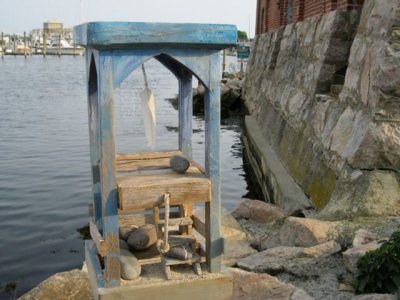
And here's one of the installations, entitled "It is Born." This poetry box was erected along the Mystic River shoreline during the summer of 2011. The box is by Ana Flores, and it contains the poem "It is Born" by Pablo Neruda.

It is Born
 
 
It is Born
 
Here I came to the very edge
where nothing at all needs saying,
everything is absorbed through weather and the sea,
and the moon swam back,
its rays all silvered,
and time and again the darkness would be broken
by the crash of a wave,
and every day on the balcony of the sea,
wings open, fire is born,
and everything is blue again like morning.
Pablo Neruda, from "On the Blue Shores of Silence."

See more of these installations at Poets and Writers and at the facebook page of Poetry of the Wild.

Get inspired. Start a project like this where you live.

Friday, June 28, 2013

Q&A with Mimi White.


(Schoodic Peninsula, Acadia National Park, Maine, USA.)

I recently had the great pleasure of meeting New Hampshire poet Mimi White. Her poems and activism on behalf of the natural world are exceptionally inspiring, both for their attention to the details of a rural life in New England and for their far-reaching vision. No wonder that Mimi’s poetry collection, The Last Island, won the 2009-2011 Jane Kenyon Award For Outstanding Poetry. She’s also published two chapbooks, one of which was selected by Robert Creeley as the winner of the 2000 Philbrick Award.  Mimi has taught at several universities and was poet laureate of Portsmouth, N.H. And on the direct activism side of the equation, she was also chair of the Rye, N.H. Energy Committee. She was also Artist in Residence at the Schoodic Peninsula of Acadia National Park in Maine.

Here are Mimi’s generous answers to a few of my questions, followed by two of her  luminous poems.

Marybeth: Tell us about the path have you walked to become the poet you are today.

Mimi: I grew up in suburban Boston with little access to anything one might call “wild”, but I was lucky enough to live around the corner from Crystal Lake which in the late 1940’s and early 50’s was still crystal-clear. There I learned to swim, ice skate ( the lake no longer freezes), and fish for all species of warm water fish including pickerel, sunfish, hornpout, and carp. I explored most of my neighborhood and beyond on foot. I think these early explorations set me on a path of inquiry into what else the world might offer in the way of a less tamed universe. Later, when I was in my early teens, I went to Camp Blazing Trail in Denmark, Maine. There I fell in love with the wilds of western Maine. This all girls camp was a training ground for learning how to live in the wilderness. We felled small trees with axes ( I did get a rather nasty cut.), built fires, cooked and baked over an open flame, created hiking trails, learned how to navigate white water in our large canvass covered canoes, and hiked several mountains, including Mt. Katahdin, the tallest mountain in Maine. I was just beginning to develop my reading life and it was at camp that I declared myself a Transcendentalist.

Marybeth:  Ah, you and Thoreau. How does the natural world inspire and inform your creative work?

Mimi: I live on a small farm, 11 acres, in a small NH seacoast town. The land informed me and created the avid gardener and orchardist, really my husband tends the fruit trees. Over the years I have walked thousands of miles back and forth to the harbor with a dog always in the lead. I have weeded, pruned, planted, harvested, canned and tended. Maybe it is the tending that connects to writing poems. I started writing poems at about the same time we bought this home and the two have always been entwined. A few years after we bought the farmhouse we bought an island home on a lake in Western Maine, my old camping stomping ground. Both the island and the farm stimulate my imagination, root me in place, and give my writing a true sense of home.

Marybeth:  What do you do to keep that inspiration alive and flowing?

Mimi: Walking and swimming make me happy and keep me sane in a world that often feels foreign and unfamiliar, snowless winters, shrubs flowering in January.

I once read that what the world needs is more people who feel alive—to find the thing that does that for you and do it. Walking, swimming, and writing make me feel most alive—they feed off of and nurture each other.

Marybeth: How does your love of nature and your creative work intersect with advocacy?


Mimi: Of course I am saddened and shocked by our changing climate. And that we are responsible for these drastic changes—that we may take so many species with us as we destroy where we live— is almost beyond comprehension. About 7 years ago my husband and I started the Rye Energy Committee—its mission is to educate town residents about climate change and what actions they might take to lessen its effects. I worked five years on that effort until I knew the committee was self-sustaining and then I resigned. Poetry??? I had so little time to address that issue in my poetry when I was working on the committee, yet I kept writing. Now, when I look back on what I wrote, I see I was struggling to make sense of the world I was living in. Birds, orchards, bats, dogs, my daily walking, trees—I recorded in my poems the land as I knew it. I think I was trying to save it as if it were a snapshot or memoir in brief lines.

Marybeth: How do you see the role of artist in advocating for nature? What unique ways of thinking and acting does an artist bring to the task?

Mimi: The poet lives in two worlds---the one we see with our eyes open, the one we see with our eyes closed. Both carry the freight of being human. Poets and other artists ask questions—we have no answers. Only inquiry and passion will lead in an uncertain future.

I designed art/energy projects when I was on the energy committee. The first project was called The Wash Day Project. The goal was to get people in Rye to forgo their dryers for the clothesline. The act of hanging out laundry is deliberate—one small step to reduce one’s carbon footprint lead to other steps—all working toward the same goal. Artists then painted these lovely clotheslines. The project culminated in an art show and talk at the local science center where we addressed climate change and what actions we could all take to curb its impact. Art transforms behavior—it is not all science and numbers.

And now? After 40 years of living on this farm we are buying land in southern coastal Maine and building a zero net energy home. It is time to live as consciously as we can about how we live—to leave a legacy for our children—a home that will require almost no fossil fuel, that might have a charging station for an electric/hybrid vehicle, that will use the sun to power our needs. We will continue to grow as much food as we can, to support our local farms and fisheries and I will continue to write poems.


Hunger
 

I had not thought the body

would be a hill

that I would need to climb every day

the table set for a stranger

even the spoons restless fidgety

cereal waiting for someone else

yet the fridge humming

the view to the orchard

known since childhood

Once a snake frightened a friend

who stopped by to visit

a small coil of happiness

sunning by the back door

but I was not there

to hear her scream

nor to tell her

they mean no harm

My oldest friend befriended snakes

in his garden

touched lightly

his skin to theirs

I had thought their hiss

the switch

that  turned on the sun

or best

the moon

like the one that rose over the hill

and I ate it whole.


What the Wind Says

for David Carroll

There is no sadness
when wind topples a pine
and leaves a hole for light to find
and darkness, too,

just the letting go
of boughs across the century,

then the long, green return.

The mind inhabits,
slowly, methodically - -
birdsong, shelter.

But imagine an emptiness so vast,
no forest, field, or rabbit hole;
no warren, den, or hollow log;

no voice in the wilderness,

who then will scribe for the wind
when the wind has nothing to say
and no place to go?


Tuesday, June 18, 2013

A.R. Ammons.


I look for the forms
things want to come as


Two brief lines from the poet A.R. Ammons.