Tuesday, May 26, 2015

I thought I knew ice.

After nearly 30 years in Alaska, after decades kayaking coastlines replete with tidewater glaciers and hiking mountains up to vast icefields, I thought I knew ice. But that’s the wonderment of the natural world: it continues to surprise me.  So when I traveled to the Antarctic Peninsula in February, I saw ice as I never had before.


Endless forms most beautiful, wrote Charles Darwin, and so it is, perhaps nowhere more evident than with ice. Yes, he was writing about biological evolution. But there is, in these giant ancient-ice bergs, an evolution as well. And an unsurpassed artistry.


Once they break from the icesheet or glacier of the continent, they live for years, decades. These bergs are so big they are named and tracked, watched by satellite. B9 sheered from the eastern Ross Ice Shelf in 1987; in 1989, it broke into three pieces; in 2010, the largest piece, B9B, collided with the Mertz Glacier, causing it to calve a massive berg.


And they travel. By current and wind they travel hundreds of miles, circling the continent, moving northward. B9 covered 1200 miles in 22 months. One berg blocked our route through the Lemaire Channel one day, but by the next had shifted, allowing passage. 


Not until this trip had I truly seen an iceberg. Growlers and bergy bits, yes, and floes. But not bergs. They are a different animal entirely. Freed from the icecap or glacier, they wander the coasts and ocean for decades, their faces changing, their bodies eroding and falling apart, until nothing is left but shards like bones.


They are not just white, but a changing tapestry of all colors, swirling in dark seas. Their ice is blue and pink and yellow, purple in dark light, and sometimes struck gold, shining like diamonds. Like the white of a color wheel, it contains all other colors, and reveals one or another or several at any given moment, in any given light and shadow, any alteration in perspective. A changing, moving work of art.


Watching the beauty before me, the constantly changing kaleidoscope of color and texture, never far from my mind was climate change. The Antarctic Peninsula is one of the most rapidly warming places in the world. Ice shelves are collapsing, glaciers and ice caps are retreating and thinning. There’s news this month of the catastrophic collapse of the West Antarctic Ice Sheet, which holds 10 percent of the continent’s ice.

The beauty and the terror of life on Earth right now. Species like Adelie penguins who nest on ice having to move farther south, away from us. The grief of what we are destroying, the joy of what remains. The beauty and the terror: not of getting trapped in the ice, but of losing the ice, the great melt underway.


There is an absence here, an absence of human presense, like a fresh breeze through an open window in a room that has been closed for centuries. It is a place to rest worry and fear, to see by the light of a new path, a new way of living on this planet. There is a lack of thinking that there is anything here for us to do, other than witness.


I still dream of moving through the ice gallery, a gallery of sculptures by elemental forces. Nature doesn’t cling to her creations, said one of my companions. It's like a sand mandala, he said, the beauty formed, and then swept away. Beauty, on a different time scale than ours. More slowly, gradually, at least from our perspective. Geologic time. Earth time.


Tuesday, April 21, 2015

St. Augustine: and the people forgot themselves.


Resurrection Bay by Rockwell Kent
 

"And the people went there and admired the high mountains, the wide wastes of the sea, and the mightly downward rushing streams and the ocean and the course of the stars, and forgot themselves."

~ St. Augustine of Hippo, Confessions

Thursday, April 2, 2015

A Year of Being Here: the mindfulness of nature and art.


I recently had a poem published in A Year of Being Here.This marvelous blog posts a poem a day, all of them "mindfulness poetry." Most are by contemporary poets, some by relatively unknown poets (like me) and others whose work you've no doubt heard of or read. Some of the voices reach farther back in time, too, to Wordsworth and Meister Eckhart and Rumi.

Mindfulness, as I understand it, is just about being in the present moment, in the here and now. While the site isn't focused on nature poetry, you'll notice that many of the poems, and accompanying artwork, are often about or set in or referencing the more-than-human world.

This is understandable, since the natural world gives us ample models of being present. Just watch a bird or tree or wild being of any kind, and you'll notice that they live their lives (as far as I can tell) always in the present moment. They don't worry about or plan the future, and they don't gnaw on what happened in the past. They do not, as the poet Wendell Berry once wrote, "tax their lives with forethought of grief."

And art: the best inspiration I've ever had has come when I am present, fully present, to whatever is going on right here and now, right in front of me. The mind eases out of the chatter of past/future thinking, and something new opens up, some new slant of light slips in.

So, mindfulness, art, nature - it's all intertwined, all same-same. And this blog, A Year of Being Here, is full to bursting with some of the most inspiring poetry I've ever read. As the curator of the blog, Phyllis Cole-Dai, writes:

If you enjoy the taste of the wild berries I’ve picked, grab a pail of your own and head for light. That’s where these poems grow; there, and in the dappled dark of the woods. You’ll have a fine time, searching for them amongst the bushes and the brambles, so long as you go slow and watch out for thorns and bears.

Sunday, February 15, 2015

Climate Change Art.

"Melting Men" by Nele Azevedo


It's been ten years now since author and activist Bill McKibben decried the fact that there was no outpouring of art helping us truly understand climate change. Without art, he wrote, we don't feel it in our gut; it isn't part of our culture.

It took awhile for art to enter the realm of climate change, I'm guessing because it plays out on such a large scale, through incremental and slow changes, and with such unimaginable long term effects that, well, it was just too much, at first, to handle. I remember the first essay I wrote about it--I used a mosaic form, a form that in itself creates a sense of imbalance, of fractured thoughts and insights. It was the only way I could approach the subject of climate change at the time, though even now trying to get my words around such an overwhelming subject, and what it means on a personal level, is challenging. 

Much has changed since McKibben's plea--at least in the art world. Politically, that's another story. I think this artistic response bears notice, for the ways in which art can speak to more than just our intellect; the ways in which it reaches the gut and the beating heart of things.

The blog Artists and Climate Change has made it their mission to track and share all forms of climate change art, from theatre to sculpture to music to literature. It's a great place to find out what's going on, to network with other like-minded artists, and to just get a sense of how we can approach climate change, not just with our intellects, but with our imaginations.


Thursday, January 1, 2015

Stanley Kunitz: A Representative Human Being.

"As an artist, you are a representative human being--you have to believe that in order to give your life over to that effort to create something of value. You're not doing it only to satisfy your own impulses or needs; there is a social imperative. If you solve your problems and speak of them truly, you are of help to others, that's all. And it becomes a moral obligation."

~ Stanley Kunitz, in The Wild Braid


Thursday, November 27, 2014

Translucent Treasures: A Guest Post by Rob Snyder.

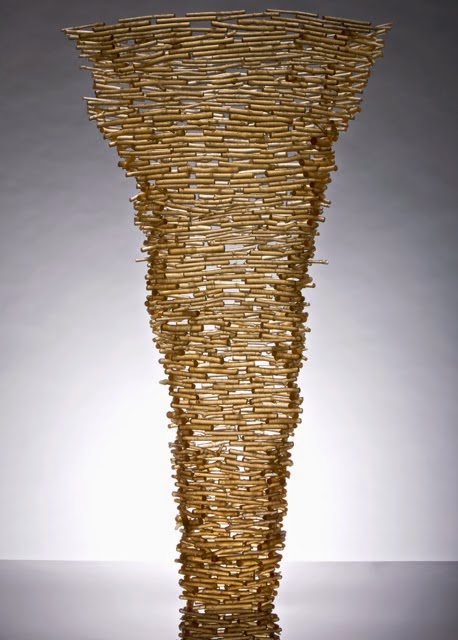
Welcome to guest blogger Rob Snyder, whose transformative glass work gives us a new perspective on things we might otherwise entirely overlook - the intricacies of the small tree branches that surround us, overhead and underfoot.


Anum Cara detail.
 
 
I have spent years gathering the branches near my studio on Vashon Island, Washington in order to create luminous sculptures made of glass branches, cast from real trees.
 
Callings.
 
Each one-of-a-kind casting is made from an actual tree branch, and then the translucent treasures are used to begin the meditative process of stacking the glass branches into form.
 
It takes over a month to complete a single piece of art.
 
Bamboo Dance detail.
 
Unless dramatically disrupted, nature regenerates itself through the life, death, rebirth cycle. Jungian scholar James Hollis speaks of nature in this way:"if we do not see nature as somehow carrying the divinity, we will continue to abuse it.”
 
Shiva's Earring.
 
 
My work, I hope, expresses the light-filled, translucent and impermanent sacredness of all that is natural.
 
Through the process I am called to look at the natural forms more closely. I see perfection and imperfection, strength, fragility and the call to preserve that which is so precious. 
 
As an artist I have come to honor these insights.
 
Autumn Spun detail.


Read more about Snyder's work in this review in Inhabitat.


Rob Snyder, a Northwest native, is an accomplished glass artist living and operating his studio on Vashon Island, Washington. Rob’s unique work from kiln cast glass has been nationally recognized in solo exhibitions, museums, private and corporate collections, group shows, and various publications. Creating art for nearly thirty years, Rob was an early pioneer in the glass fusing movement. Over the years he has made important contributions as an artist, designer and builder of glass equipment, assistant to notable fine artists, glass technician, and teacher. Currently, Rob is working on a large commission for a private collector and on several other pieces to be included in shows around the country. Rob is represented by Freisen Gallery in Sun Valley Idaho, Abmeyer and Wood Gallery in Seattle Washington, Echt Gallery in Chicago Illinois, and Austin Arts Projects in Palm Desert California. In addition, Rob is expanding his gallery representation both nationally and internationally. To meet the growing demands for his art, he is undertaking the creation of Steppingstone, an artist residency program on his property on Vashon Island. Learn more at his website at www.RobSnyderArt.com and his Facebook page www.Facebook.com/RobSnyderArt.


Thursday, October 23, 2014

Kandinsky and the Crazy Piano Guy.


Detail of Wassily Kandinsky's Quartet
 
It was our second day in New York City. We awoke to a drenching rain, bought two umbrellas from a vendor just outside the hotel door, and walked to the Museum of Modern Art. But the rain had driven everyone to the museum, and we had to wait in a long line, outside, in the rain. Finally, our wet umbrellas tucked into museum-provided plastic bags, we entered.
 
There I spent at least an hour in just one room, with four Kandinsky paintings, while scores of people streamed by. The wash of color, texture, patterns across the canvases looked to me like music, so I wasn’t surprised to then read this quote by Kandinsky: “Color is a means of exerting direct influence upon the soul. Color is a keyboard. The eye is the hammer. The soul is the piano, with its many strings.”

The skies cleared by late afternoon, so we hopped a subway to Greenwich Village and wandered its streets, finding ourselves at Washington Square, where throngs enjoyed the rain-cleansed evening light. Near the center fountain, a man clothed entirely in silver, like the tin man but wearing a suit and top hat instead, held perfectly still. A little girl in yellow rubber boots walked up and put money in his bucket, and the mime began to move. We sat watching his flowing dance, and listening to a young woman singing jazz accompanied by a stand-up bass off to our left.

Then we walked through the park to where a man played a baby grand in the middle of the sidewalk. My first thought: how on Earth did he get this piano here? My second thought: what beautiful music. Tattoed and dressed punk, this man played song after song of some of the most vibrant classical music ever composed.

It was late; we were hungry; but we couldn’t pull ourselves away.  A strong wind came through, playing chorus in the trees. It was one of those moments.

Even in New York City, where the natural world is so contained and replaced that it seems irrelevant, even here, in this moment, I could see the interplay between human creativity and the creativity of the natural world. The way we can be in harmony. Literally.

I turned my smartphone up to the trees and the wind, and made this brief video:


Later, I learned the piano player, Colin Huggins, had been the music director for the Joffrey Ballet Company, but decided he wanted to do something more interactive with people, and so began this life of busking. He actually pushes the piano from a nearby storage building to the park, dodging traffic, to the sidewalk, all by himself.

It’s crazy, but it’s that kind of crazy creativity and devotion to doing what one loves that makes New York the amazing city it is—and that makes me feel hopeful for the future of humanity and the natural world.

All of human creativity originates in the natural world, music from the sound of wind through trees. And it can be reciprocal: we can use our incredible gifts of creativity to expand our knowledge, awareness, and harmonious existence with the rest of this living, breathing, creating world.

Let’s.